The Centralized Illusion: Why Modern Messengers Leak Your Life and How VeilMesh Rebuilds True Privacy
Most "secure" messengers protect the contents of your messages, but fail to hide who you talk to, when you talk, and where you are. We expose the hidden compromises in modern messaging systems and how VeilMesh uses zero-trust metadata-masking and offline mesh routing to rebuild true sovereignty.
Over the past decade, End-to-End Encryption (E2EE) has gone from a niche feature for cypherpunks to the default standard for billions of users. Mainstream secure applications have made it a baseline expectation that the content of our conversations remains shielded from eavesdroppers. This has been a massive step forward for global security.
However, this widespread success has created a dangerous false sense of security—what we call the centralized illusion. By focusing exclusively on message content, modern applications have left users vulnerable to metadata profiling, server-level censorship, and store-level bans. Here is why the current paradigm is broken, and how VeilMesh is redesigning communication from a zero-trust, offline-first perspective.
1. The Metadata Honeypot: Knowing the "Who" and "When"
Even if a messaging company cannot read the text of your message, their servers still know exactly who you are talking to, when you sent the message, and what IP address you used. This metadata forms a digital footprint of your social graph.
For adversaries, metadata is often more valuable than content. If a government agency can see that a journalist contacted an anonymous source at 2:00 AM, followed by a call to their editor at 2:05 AM, they have reconstructed the story's origin without needing to read a single word of the text. Furthermore, almost all modern secure apps still require a phone number to register, tying your cryptographic keys directly to a state-registered SIM card.
The VeilMesh Approach: We eliminate SIM card registration entirely; your identity is derived from hardware-isolated keys, not a phone number. To protect metadata during transit, we implement Sealed Sender. By encrypting the sender's identity wrapper, the relay server acts as a blind mailbox. It handles the delivery of opaque transport packets to a destination hash, but has zero knowledge of the sender's identity or IP history.
2. The Centralized Registry: Single Point of Censorship
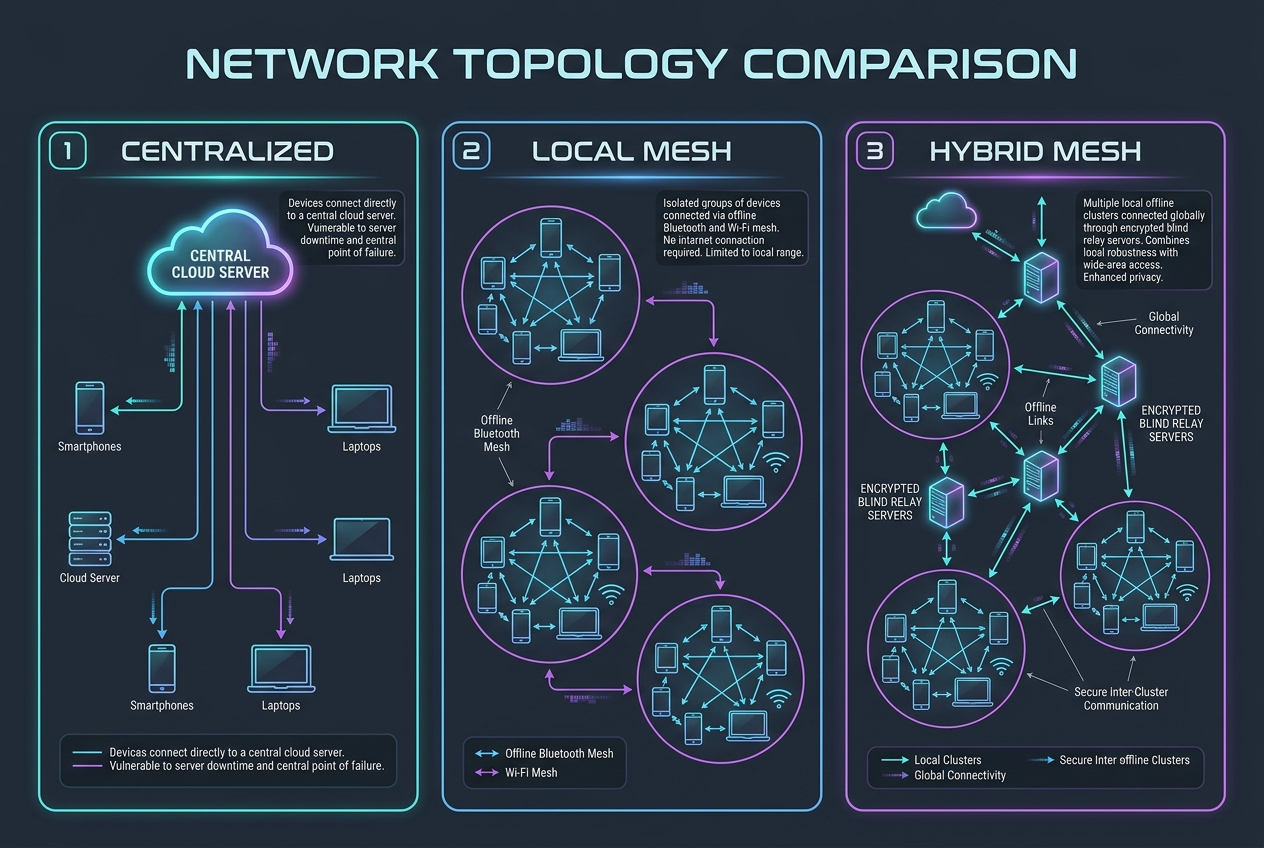
Even the most secure messengers rely on centralized server registries. If a platform's servers in Amazon Web Services or Google Cloud go offline, or if a national firewall blocks their domain and IP ranges, the application ceases to function. Users are left in the dark.
This centralized bottleneck makes secure messaging vulnerable to state-level internet shutdowns. In regions experiencing civil unrest, natural disasters, or grid failures, traditional messengers are rendered useless exactly when secure communication is needed most.
The VeilMesh Approach: VeilMesh is built for offline resilience. If cellular networks or the global internet grid fail, the app dynamically routes packets peer-to-peer using Bluetooth Low Energy (BLE) and local Wi-Fi Direct. Messages "hop" dynamically from device to device until they reach their destination. When online, VeilMesh uses cooperative WebRTC proxy tunnels and obfuscated blind relays to bypass state-level firewalls.
3. The App Store Monopolies: Account Linking vs. Cryptographic Decoupling
Most secure messengers are distributed through centralized app stores run by Apple and Google. Downloading an app from these stores requires linking the action to a personal Apple ID or Google Account, which is tied to real-world billing addresses and payment cards. In many mainstream messaging apps, this store profile is immediately tied to your in-app account (via telephone number registries or telemetry tracking), creating a clean audit trail linking your real-world identity to your cryptographic chat keys. Furthermore, centralized distribution exposes users to targeted, silent malicious updates pushed by the store operators under state coercion, or sudden local store bans.
The VeilMesh Approach: VeilMesh mathematically decouples your app-store downloader identity from your in-app communication keys. Because there are no phone number registrations, emails, or telemetry logs on our backend, downloading VeilMesh from an official store does not link your Apple ID or Google Account to your unique on-device Veil ID (which is generated fully locally inside the Secure Enclave after installation). To defend against platform-level censorship and targeted updates, we support direct sideloading of signed APK binaries, direct verification of git-release signatures, and local device-to-device sharing. You can transfer and install the exact same verified VeilMesh app binary from a nearby peer's device over local BLE/Wi-Fi Direct without touching the internet or logging into any app store.
4. The Group Scaling Crisis: Pairwise vs. Tree-Keys
Standard secure group chats are computationally expensive. In traditional secure messengers, if you send a message to a group of 100 people, your phone has to encrypt that message 100 separate times and upload 100 separate copies. This pairwise ratcheting model drains batteries and chokes bandwidth on slow connections.
The VeilMesh Approach: We leverage the Messaging Layer Security (MLS, RFC 9420) protocol. MLS uses tree-structured group keys, meaning the computational overhead of group operations (adding/removing members, rotation keys) scales logarithmically rather than linearly. This allows large secure group chats to run smoothly even over constrained Bluetooth links in an offline mesh network.
5. Centralized Feeds vs. Epidemic Broadcast Channels
In legacy messengers, "channels" (broadcast feeds) are stored on centralized database servers. When a creator publishes a post, it resides on the server, and subscribers download it directly. If the government blocks the server, or forces the platform to delete the channel, the content is permanently erased. Furthermore, in some centralized platforms, even "private" channels are stored in decrypted plaintext on their company servers.
The VeilMesh Approach: VeilMesh introduces fully decentralized broadcast channels utilizing epidemic gossip routing. When a channel administrator publishes an update, the post is cryptographically signed by their root identity. This signature makes the message tamper-proof. The signed update is then flooded through the mesh network: nodes relay and store channels they subscribe to, or serve as temporary transit hops. If a user is offline, they can dynamically synchronize the latest channel history from any nearby peer who has already received it, bypassing the need for a central server entirely.
Security is baked directly into the channel design:
- Authenticity & Integrity: Every broadcast update is signed using the creator's hardware-isolated private identity key. Transit nodes cannot alter a single byte of the content without breaking the cryptographic signature, preventing spoofing and injection attacks.
- E2EE Private Channels: For restricted channels, posts are encrypted using a symmetric channel key shared only with authorized subscribers. Transit peers who route and relay the data carry only ciphertext—they have zero capacity to decrypt or read the feed contents.
- Subscriber Anonymity: In centralized applications, the server maintains a complete list of a channel's subscribers. VeilMesh protects subscriber privacy by using blinded topic hashes. Nodes filter and retrieve channel updates from the gossip stream without revealing which specific feeds they are actively following or reading to routing peers.
6. UX Compromises: The Illusion of Perfect Forward Secrecy (PFS)
The most dangerous vulnerability in modern commercial E2EE messengers is the hidden downgrade of cryptographic guarantees to support convenient user-interface features, such as editing messages, historical synchronization, or reactions. In several mainstream secure apps, when a user edits an already sent message, the application alters the cryptographic context. In the message details, the user can suddenly find the status: "Perfect Forward Secrecy: No".
To avoid complicating the server-side rewriting and key-ratcheting logic during edits, the system rolls back to a fundamentally less secure state, relying on static or long-lived keys. If one of the current keys is compromised in the future, the attack exposes not only the edited text but the entire volume of the associated historical conversation, stripping the user of the core guarantee of forward secrecy.
The VeilMesh Approach: VeilMesh fundamentally refuses to compromise cryptographic mathematics for UI/UX convenience. In our architecture, any action—whether sending a new message, editing content, deleting a payload, adding a reaction, or transmitting a system frame—is processed as an atomic cryptographic operation within the Double Ratchet or MLS protocols. Each edit pushes the cryptographic ratchet forward and generates a unique, single-use key. There is no scenario in VeilMesh where an interface feature can temporarily "disable" PFS or weaken the protocol. If a feature cannot be implemented while strictly maintaining Zero-Knowledge and PFS, it is redesigned at the architectural level rather than lowering the security bar.
Conclusion: Reclaiming Digital Sovereignty
End-to-end encryption was the first step in protecting digital privacy, but centralized infrastructure has become the new vector of control. By decoupling communications from SIM cards, replacing centralized servers with blind relays, integrating local mesh fallback, and leveraging decentralized, cryptographically masked PubSub feeds, VeilMesh shifts the power back to the user. True privacy is not a setting—it is an architecture.